by Teresa Gryder
On the river we use hand and paddle signals, and review them at the beginning of club trips. We often have people coming from different traditions, regions and styles, and signal use is marginally effective.
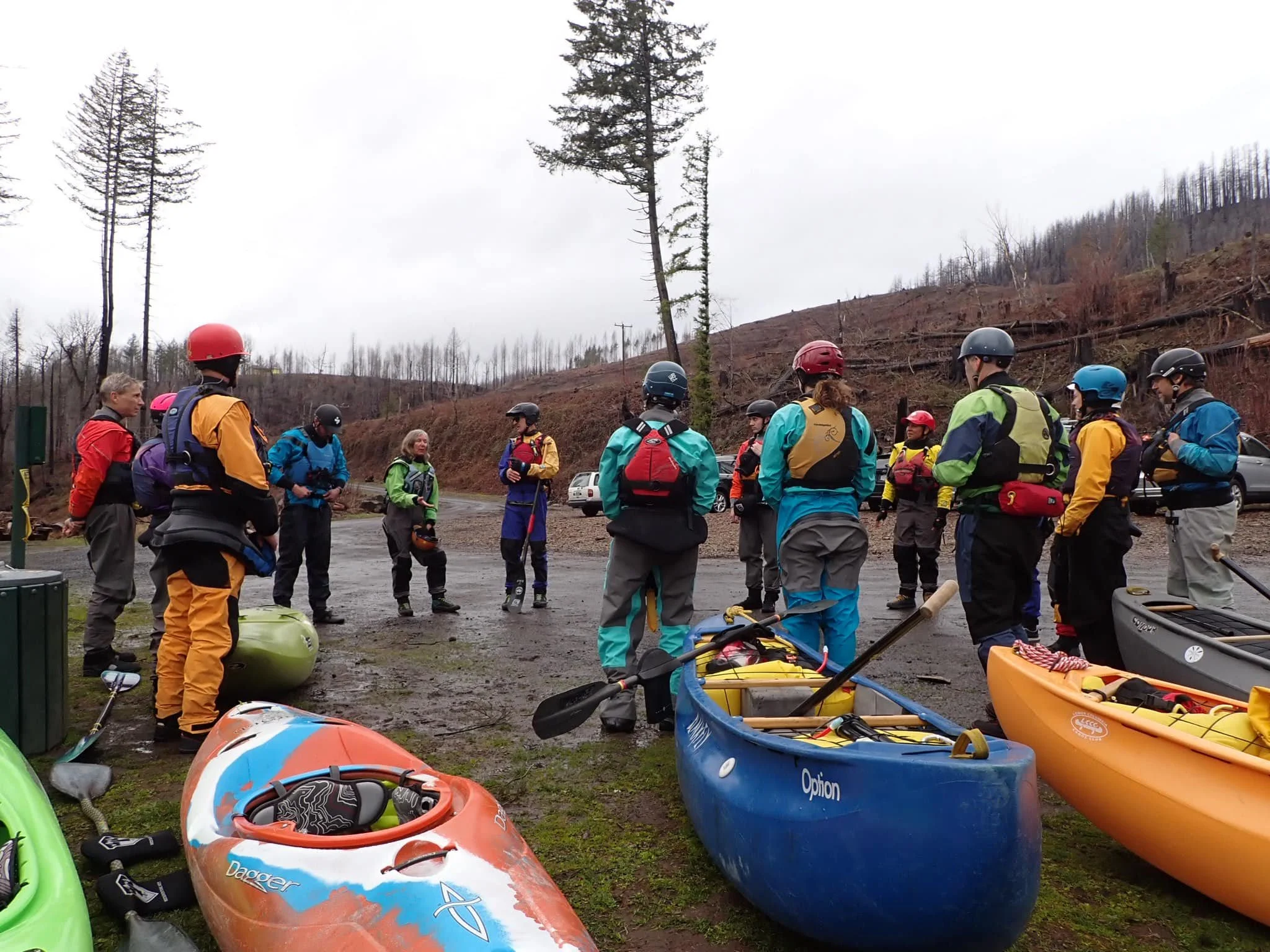
Circling up before a trip to discuss signals and other safety protocols.
I get frustrated when paddlers don't see my signals. I am trying to help and they are not getting the message. Usually it’s because they are not looking. Some are so busy surviving the rapids that they don't have the bandwidth to scan for more information. Others simply do not expect or trust me to give them good information. When I do manage to connect and convey useful info, it is satisfying, and it enhances our safety.
On club trips, large paddle signals given way in advance get seen and repeated. Everybody knows to pass a signal back by repeating the signal for those behind them. Sometimes paddlers sacrifice themselves on the rocks to do so. Then, even though the signal has been seen and repeated, action is slow to occur. For example if the signal says "go left" people still won't go left until they see the hazard for themselves. Other boats driving to the left is a more effective signal than a paddle.
This is more of an observation from my instructional courses than anything else. This summer I made the predictable (but new-to-me) observation that most paddlers won’t take their eyes off of their line unless they hear a whistle. The more nervous the paddler, the more likely they will need a whistle blast to get their attention. If you are giving hand or paddle signals to someone in the water, be sure to accompany the signal with a single whistle blast. --Luc Mehl, the Alaska ice-skating and packraft guy
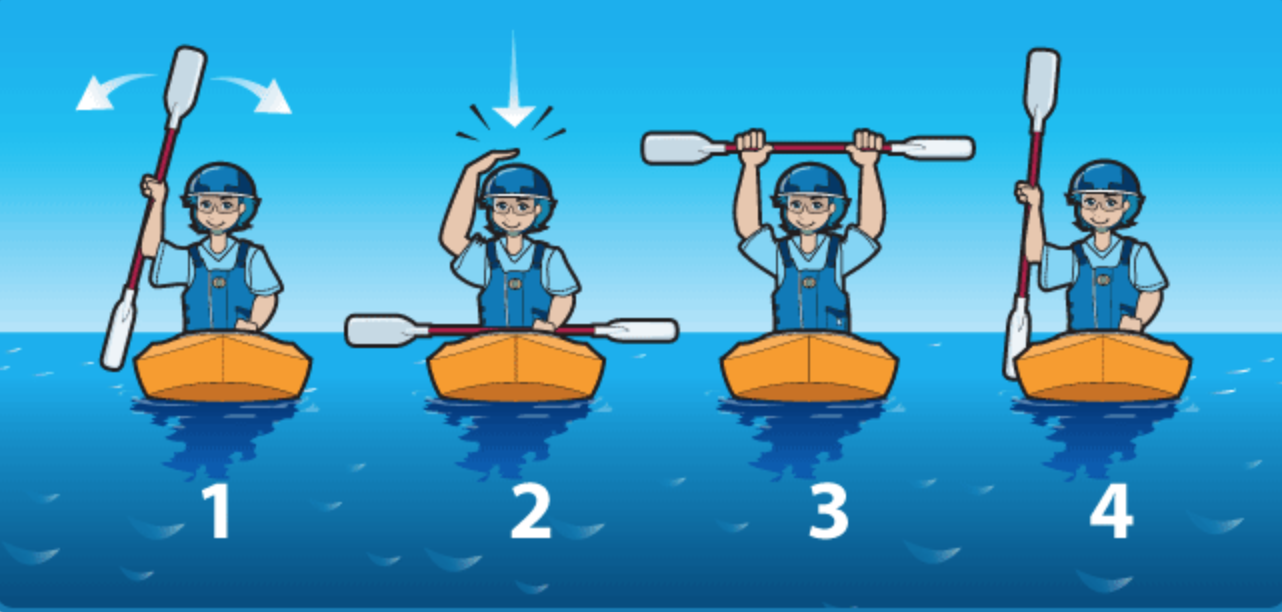
River signal illustration from the state of Oregon boater training.
Whistle use is another fraught topic. Some people blow their whistles for every little thing, while others (like me) tend to reserve them for the worst situations. For me to use a whistle to get people's attention for a routine signal, I will need to make some changes. First, my attitude; I am taking Luc’s advice. Then, I need to locate my whistle where I can blow it without having to fiddle around for it. And last, I will need to wear ear plugs, because the sound of the whistle is painful to my head. Still, I'm going to do it. Brace yourself for a new level of whistle use. I'm hoping to get our paddlers started noticing more signals.
Broad awareness facilitates higher levels of paddling. To run hard stuff you need to be practiced enough to calm down. If you have a hard time looking around on easy runs, keep doing them until you chill out. Track the locations of the other paddlers, and adjust your spacing for the best flow. If someone is hot on your tail either eddy out or speed up. Help others by noticing when their lifejacket isn't zipped or their drainplug is out. Consider that someone who just swam might need help emptying their boat. Catch eddies in the middle of rapids to really look around.
With a tight crew, small signals occur continuously. A chin can point. Eye contact confirms you are both watching and will see what the other is doing. Knowing each other makes teamwork easier. It takes time, repetition, practice to gain the comfort that allows awareness. There are no shortcuts.
"You go home if you're careful enough and thankful enough." --Jeff Snyder