Seal Launch as a whitewater kayaking skill
Seal launching in a whitewater kayak is when we drop into the river from a rocky height, imitating the named mammal. It’s a lot like running waterfalls, but without the fluid stuff to grab with your paddle, and without a hole at the bottom. It’s the bones without the flesh. It might seem safer or easier, but it isn’t, because fluid helps. It takes forethought and presence of mind to pull off a good landing after a seal launch from dry rock.
Any reasonable person might ask WHY do such a thing? There is one good reason; it could be the best way to get back into the river. Sometimes there’s no nice beach at the river’s edge where you can put on your sprayskirt before you scooch back into the water. Sometimes the eddy is boiling and there’s nobody to hold you, or the portage cliffs out and you can’t climb down to the water. It feels great to get 100% put together before dropping into a chaotic piece of river.
I’m not sure I’ve made all the possible mistakes, but I’ve made plenty. You can land too flat, or too vertical. You can flip over on landing, hit something on the way down, or get turned around backwards or sideways. You can fail to get your sprayskirt on all the way before shoving off, fill with water or land on a rock.
My first big seal launch was in a “combat” situation; I had never practiced the skill. We were running the Flying V Gorge of the Salt River in Arizona, a remote 25 mile section that the Apaches hold sacred. The Salt River runs between two Apache clans, and we “white eyes” are allowed on the lower reaches of the river, and by permit only. We snuck in to run the forbidden section.
The water was low and we wanted to finish the run in one day, so we didn’t dally, moving steadily downstream through a temple of sculpted white granite and waving at Apache fishermen. We made seven portages that day, but only one required that we seal launch. I made at least two mistakes on that launch: I landed too flat, and upside down too.
I think it was our 4th portage. We had landed on a nice flat ledge on the left to scout. On seeing the rocky falls we decided not to run it. We carried our boats downstream along the ledge while the river fell away beneath us. At the end of the rapid the river looked deep, green and calm, and the ledge we were on overhung the river. It seemed obvious that we should get in our kayaks and plop in there.
I went first. The rocky edge of the cliff was rather too square, and I didn’t exactly like it the looks of it, but there didn’t seem to be another option. I had been off a twelve-foot waterfall but had never seal launched twenty feet.
I inched forward in my kayak, sitting on the flat shelf. When the boat started to teeter over the edge I went with it. While falling through the air my kayak rotated forward and I landed flat upside down. I almost passed out, perhaps due to the stretch to my spine, as my legs did not come out of the boat. I felt really dizzy and weird. Mammalian reflexes kept me from inhaling water until I came to my senses and rolled up.
In hindsight that could have been the end of me. A 20+ foot drop to a flat landing on hard green water would be bad even if you landed right side up, but I landed upside down and was barely conscious. The water was sliding into another rapid, and my buddies and their boats were up on a cliff over my head. If I had passed out, only they could have saved me, and they faced the same obstacle before they could get to me. It worked out, though; I rolled up and eddied out. My buddies launched better than me, though I couldn’t say exactly how, because I was out of it. Somehow we finished the run at last light without getting scalped.
That day gave me more respect for what can go wrong with a seal launch, but also for its usefulness. On the river every option has risk, and we choose among risks by our own personal standards. Seal launching when not needed is a risk, but you won’t get good at it without practicing.
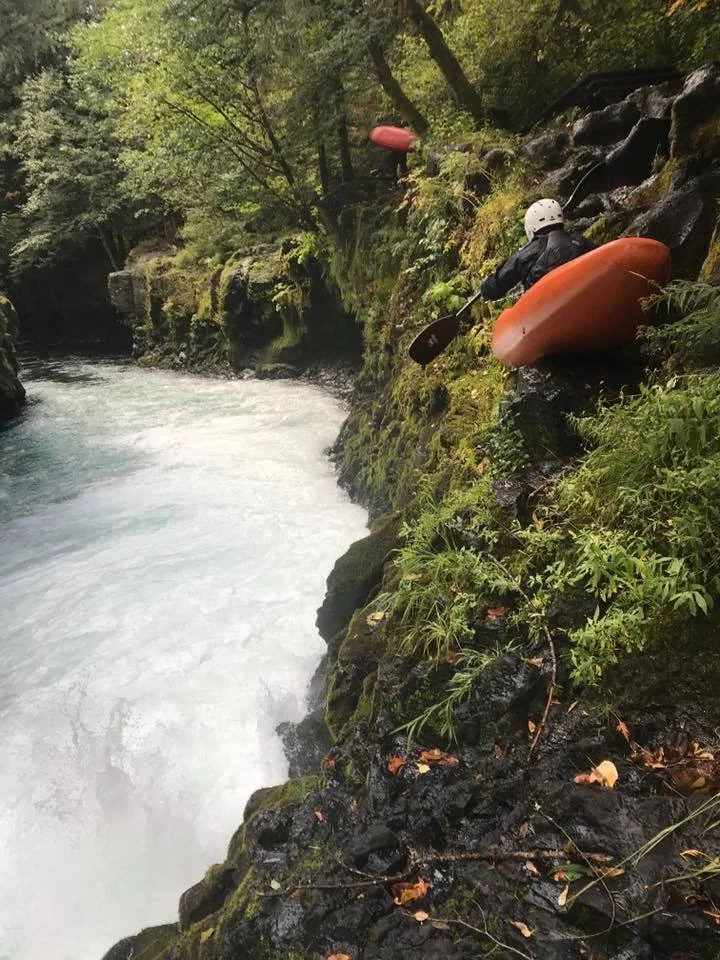
Getting ready to seal launch below BZ.
Consider BZ Falls on the White Salmon in Washington state. If you don’t want to run it and refuse to do a seal launch, you’ll have to carry your boat a long way to a launch spot that is no picnic. The seal launch may be easier. The first possible launch site you come to is an exciting ramp to the water just feet downstream from the falls. It’s not obvious, but if someone shows you how to set up and launch, you’ll bounce down the rock slide to a final bump that sends you to a flat (dry!) landing in the boiling outflow. It’s pretty easy, just terrifying to contemplate. There’s another seal launch spot farther downstream, over a sharp edge that risks the same bad outcome as my first attempt—over-rotation and a green water landing. I don’t recommend it. Later I learned that you can control the boat’s rotation by planting your paddle on the rock and doing a boof stroke of sorts. Having some speed as you slide toward the edge makes it easier to use your paddle to control the boat’s rotation—with or without water.
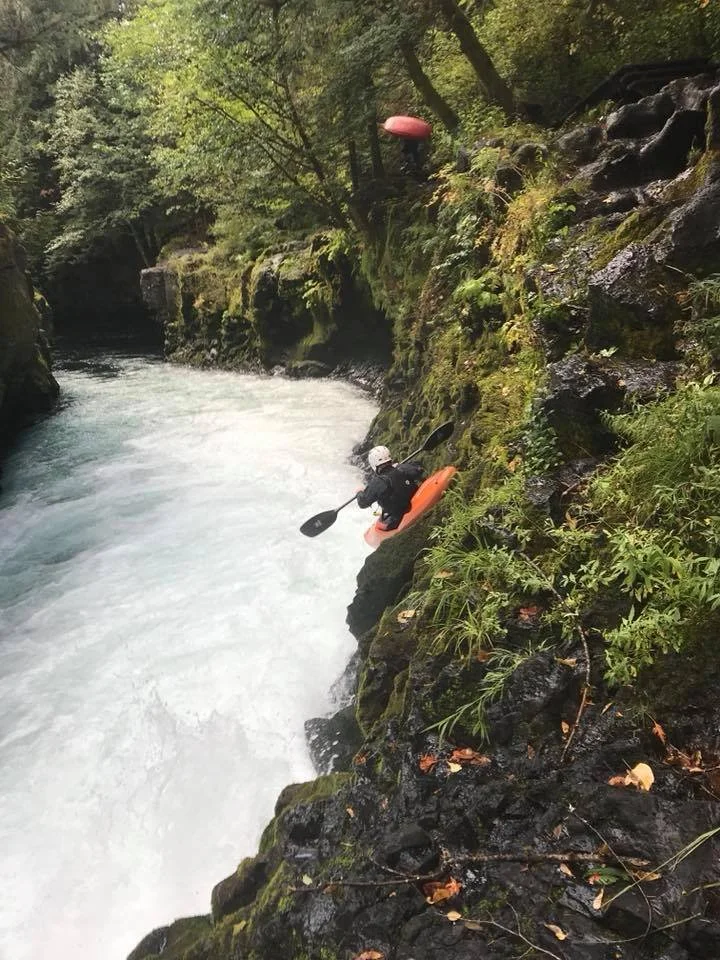
Sliding into the water below BZ falls.
The only way to get good at seal launching is to do it. Compared to the rapid that we are portaging, dropping off a little cliff into relatively calm water can be the conservative option. Learning to pick and execute a predictable seal launch is a skill worth having.
There are a lot of considerations. A clean landing zone is important. I learned the hard way that the edge really matters. Having a ramp to build your momentum in the right direction is ideal. At the top of the ramp you need a secure perch where you can get in the boat and get ready. If your perch isn’t super stable, get someone to hold your boat until you are ready. Make sure you are put together: sprayskirt, noseclip, pogies, paddle, check. If someone is holding you, communicate about whether you want a push or not. Use your paddle on the rock to adjust your angle and momentum as you launch. Body position while landing matters too; you want your core tight, body upright or forward so you’re ready for whatever comes next. It’s intuitive to lean back but as you get better at boofing and seal launching you’ll find the best results come from not yielding to that instinct. You also want your elbows up to avoid banging them on the deck (don’t ask me how I know). It’s a lot.
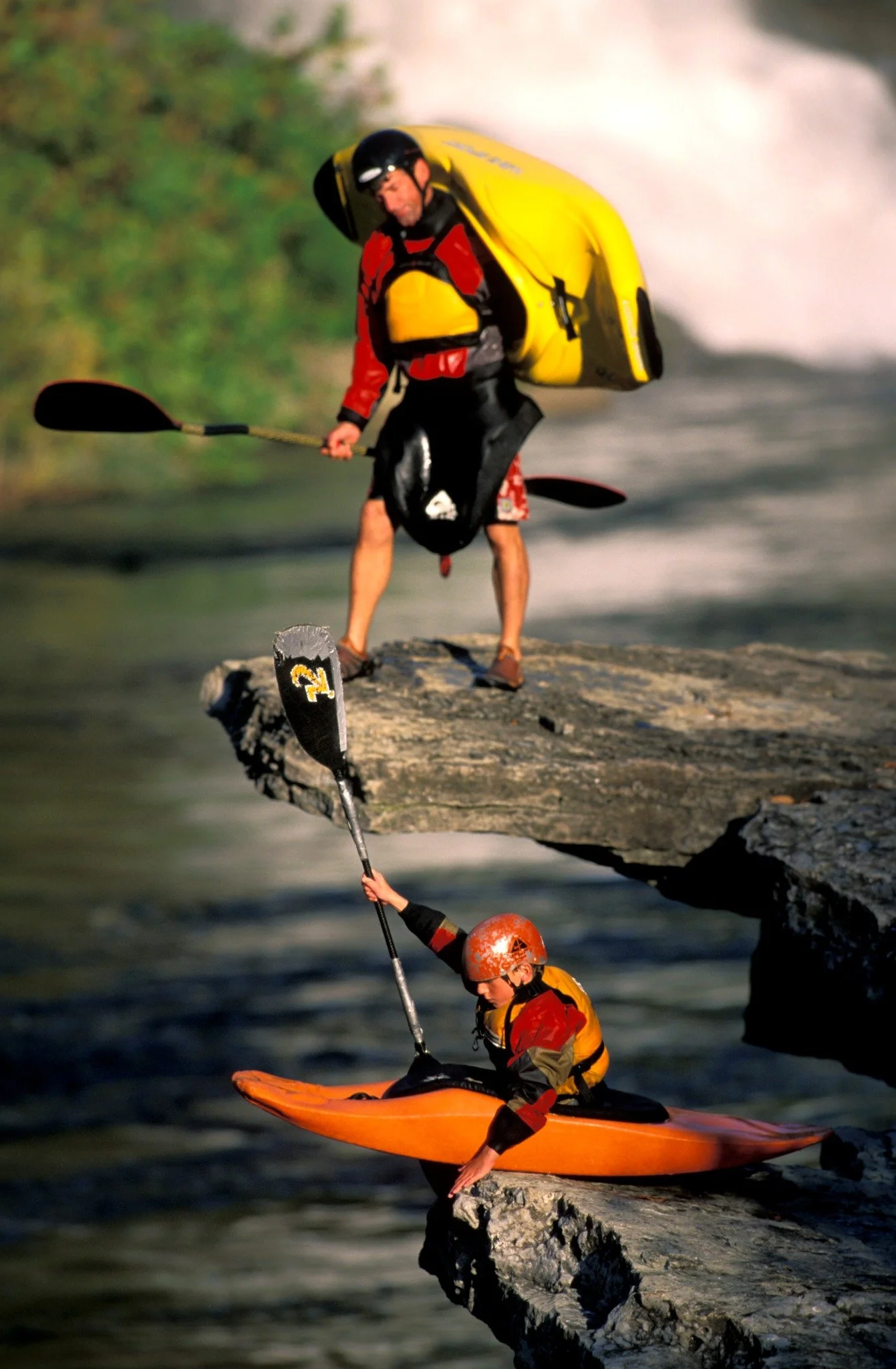
A young Dane Jackson getting tips on seal launching from his dad EJ.
Let’s think a little harder about that edge, since it is so important. The best edge for seal launching is something that ramps you down to the water so that your landing is smooth. Ideally there’s room to slide some distance down the rock before the edge, giving you speed for a controlled launch. Sometimes there’s no room for sliding and you depend on a buddy to give you a push, or use your paddle in one hand and your hand on the rock on the other side to push off like baby Dane, above. Regardless of how you get your speed up, it helps you clear the edge and hit the water with a reasonable angle.
To find a good seal launch spot I stand on the rock with my boat and slide it back and forth on the edge to see where it wants to go. Then I drag it up to the starting perch, making sure that when I tilt off my perch, I’ll slide to the right spot. By dragging the boat around I find channels in the rock where the boat wants to slide. There’s no guarantee, but I’m trying to go off the edge with speed and in the right spot.
If you’re going to try practicing seal launches, start small. Slide in off a 5 foot drop to get the feel of it. Each additional foot of height adds force to the system. Find a favorable edge and a deep spot, and take the plunge just to see what will happen. Take a deep breath, and take your time. The river isn’t pushing you. Push off the rock with your paddle as needed, pull your belly forward while you fall, and keep your elbows off the deck. Using these tips you have fair to middlin’ odds of getting into the water without trouble. If you do land wildly, at least you’ll be ready to brace.
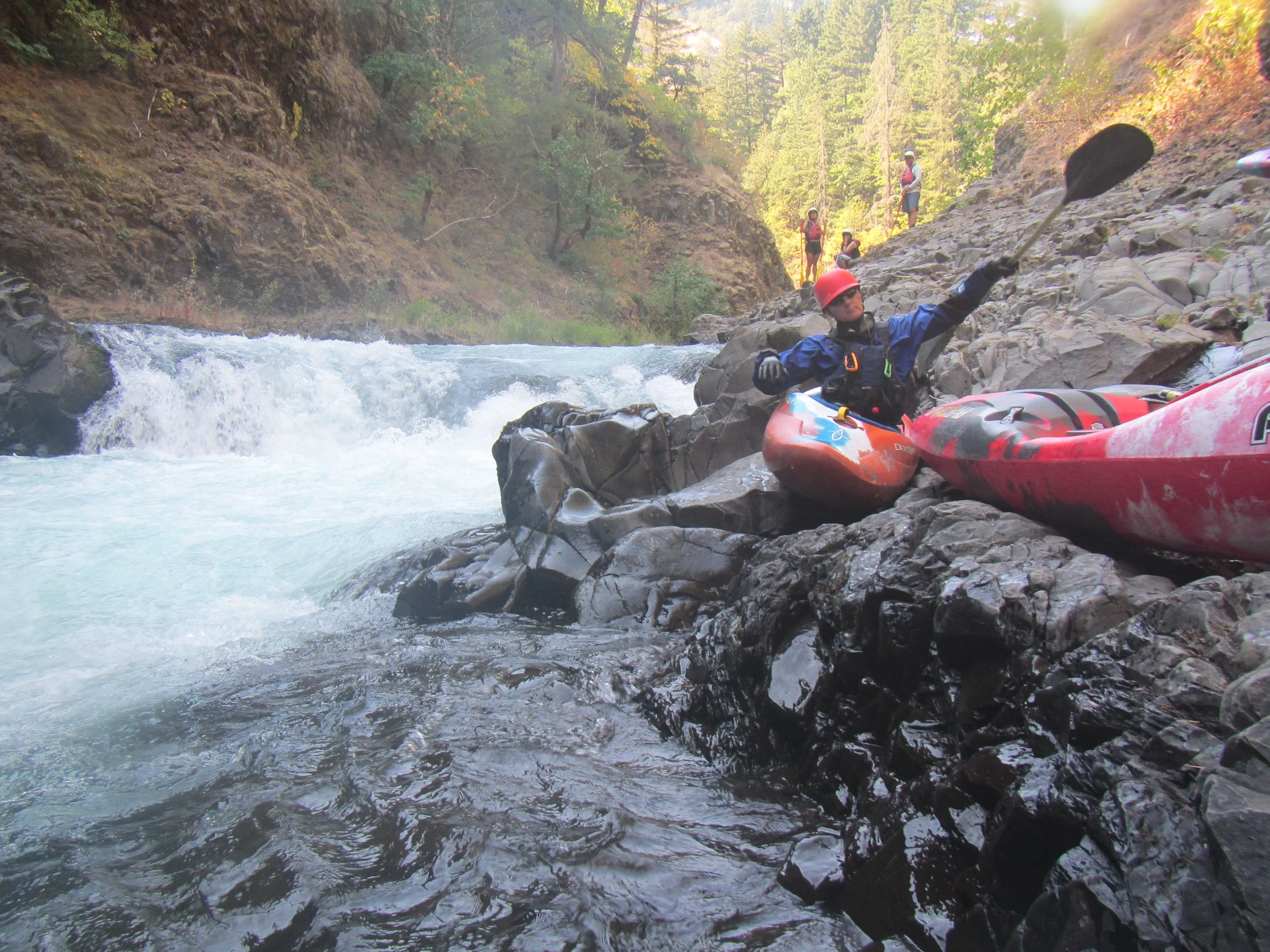
Joe gets ready to do a small seal launch below Steelhead Falls on the Bottom White Salmon, photo by Teresa Gryder.
10 TIPS FOR SEAL LAUNCHING
Pick a spot on the edge that leads to a good landing in the water.
Pick a boat perch from which you can slide to your edge.
Get someone to hold you if you don’t trust your boat to stay perched.
Get in the boat and put together: sprayskirt on, noseplugs, pogies, paddle
Signal when ready for your push—or start yourself sliding on your own.
Use your paddle on rock to adjust your launch trajectory.
Smile for the camera.
Land in ready position.
Roll up.
Be available to T-rescue anyone who goes after you and has trouble.